
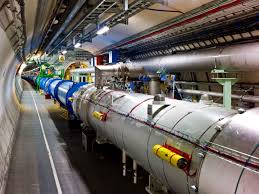
Recently, physicists at the Large Hadron Collider, or LHC for short, observed a behavior in decays of particles called D mesons. It was previously calculated years ago by physicists that this type of behavior would occur in these particles, but was only observed for the first time recently, fitting the standard model of particle physics.
So what does this all mean?
To be honest with you, it is all still pretty confusing for me too, so I’m just going to break down the basics of it here. If you’re interested in the full article, the hyperlink in the first paragraph has got you covered.
The article states that “the discovery reveals one small mechanism that contributes to there being more matter than antimatter”. This furthering of our understand of why there is such a ratio of matter to antimatter in the universe is imperative for learning what antimatter truly is. Our knowledge of it defines it as “a material composed of the antiparticles (or “partners”) of the corresponding particles of ordinary matter.” If its value were equal to that of matter, the universe would be empty, and we would not be having any discussion about this right now, or anything for that matter.
Luckily for us, that is not the case, and the universe is teeming with matter and objects of all sizes. So the question still remains: why is there such a disparity between the two? This finding gets us closer to that answer, but still doesn’t account for the whole thing, the article suggests.
There are still more experiments to be done with the Large Hadron Collider and more findings to be had, and hopefully they make another significant breakthrough soon.
 JustInScience